Smarter Crop Health Monitoring for Higher Yields
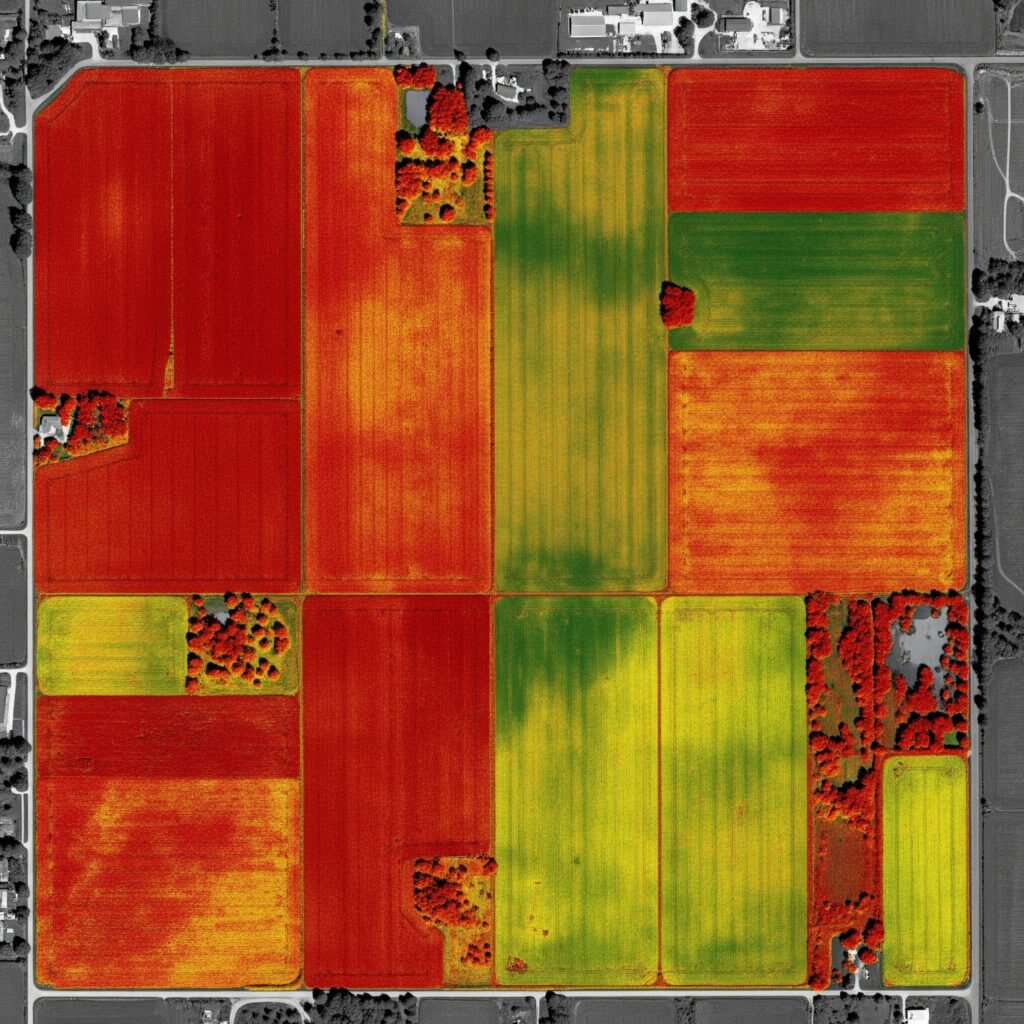
NDVI drone mapping near Lisbon is becoming one of the most practical tools for farmers who want to protect crop health and increase yields. In regions like Lisbon, Ribatejo and Oeste, where vineyards, orchards, cereals and forage crops all coexist, understanding variability inside each field is just as important as choosing the right crop. NDVI drones for agriculture in Portugal give farmers a clear, visual way to see where plants are thriving and where they are struggling, long before problems are obvious to the naked eye.
NDVI drone mapping Lisbon: the regional context
The Lisbon region and the nearby Ribatejo and Oeste areas form a mixed agricultural zone with everything from river‑valley maize and vegetables to coastal orchards and high‑value vineyards. Fields can vary in soil type, drainage, exposure to wind and availability of water, even within a few hectares. Traditional field scouting is still essential, but it is hard to see every square metre at the right moment. NDVI drone mapping in Lisbon fills that gap by capturing the whole field in minutes and highlighting where attention is most needed.
In practice, this means farmers can move from a “whole‑field average” approach to truly precision agriculture in Lisbon. Instead of treating every hectare the same, they can understand the real pattern of crop vigour and tailor irrigation, fertilization and crop protection to the actual conditions on the ground.
NDVI drones for agriculture Portugal: what NDVI is
NDVI, or Normalized Difference Vegetation Index, is a way of measuring plant vigour using reflected light. Healthy plants absorb more red light for photosynthesis and reflect more near‑infrared light, while stressed or sparse vegetation reflects these wavelengths differently. By comparing the difference between red and near‑infrared, NDVI produces a value that corresponds to how “vigorous” the vegetation is in each part of the field.
When NDVI data is collected by drones, it becomes a high‑resolution NDVI plant health map that shows detailed variability across the field. Each pixel in the map corresponds to a small patch of crop, with colours representing different levels of plant vigour. This gives farmers a simple, intuitive way to see where crops are underperforming and where they are doing well.
NDVI crop health in the Lisbon region: key benefits for farmers
One of the greatest strengths of NDVI drone mapping Lisbon farmers appreciate is early detection of stress. Because NDVI responds to changes in canopy density and photosynthetic activity, it often shows problems caused by water stress, pests, disease or nutrient deficiencies before the crop visibly yellows or wilts. This early warning allows targeted field walks and timely interventions that can protect yield and quality.
Another major benefit is better irrigation planning and fertilizer optimization. NDVI plant health maps reveal over‑ and under‑performing zones that often correspond to differences in soil, drainage or irrigation coverage. Farmers can use this information to adjust irrigation schedules, check clogged or leaking lines, and refine fertilizer strategies so that more inputs go where they are really needed. Over time, this supports more efficient use of water and nutrients and can reduce unnecessary costs.
For vineyards and orchards in particular, NDVI drones for agriculture in Portugal support yield and quality zoning. Blocks rarely behave as a uniform unit; some rows or sectors consistently produce better fruit than others. By analysing NDVI patterns across the season, growers can define management zones, adjust pruning or thinning strategies, and even plan selective harvests or separate vinification of different parcels based on their vigour.
Drone crop monitoring Lisbon vs satellite NDVI
Many farmers are already familiar with satellite NDVI from online platforms. Satellites are useful for viewing large areas and long time series, but they have limitations in detail and timing. Resolution is often too coarse to distinguish within‑field variability for smaller plots, and cloud cover can hide fields exactly when information is most needed.
Drone crop monitoring in Lisbon solves these issues by flying below the clouds and capturing centimetre‑level resolution exactly when the farmer needs it. NDVI drone mapping Lisbon can be scheduled around key growth stages, irrigation events or suspected problems, providing sharp detail of headlands, individual rows and subtle patterns that satellites cannot see. This makes drones a complementary, higher‑precision tool that works alongside broader satellite monitoring.
Precision agriculture Lisbon: how an NDVI drone survey works
A typical NDVI drone survey near Lisbon follows a clear workflow that is easy for farmers to integrate into their season.
1. Planning and objectives
The process starts with a short consultation to define objectives: crop type, field location, current growth stage and key questions (for example, checking irrigation uniformity, investigating yellow patches, or planning variable‑rate fertilizer). At this stage, the flight is planned, considering field boundaries, legal airspace, and the best time of day for light and wind.
2. Flight and data capture
On the agreed date, the drone pilot goes to the farm and flies systematic routes over the field using a multispectral or NDVI‑capable sensor. The drone records overlapping images that cover the entire area, ensuring consistent altitude and geometry. Because drones move quickly and efficiently, several fields can often be captured in a short time window, which is valuable in busy growth stages.
3. Processing and NDVI plant health maps
After the flight, the data is processed using dedicated software that stitches the images into an orthomosaic and calculates NDVI for each pixel. The result is a georeferenced NDVI plant health map that can be delivered as an image, a PDF map, or a GIS‑ready file. Colour scales are chosen to make it easy to distinguish low‑vigour, average and high‑vigour zones.
4. Interpretation, reports and agronomist collaboration
Data only becomes value when it is interpreted. A good NDVI drone mapping Lisbon service includes a summary report explaining the main patterns, potential causes and suggested “priority zones” for field scouting. Where possible, this is done in collaboration with the farmer’s agronomist, combining local knowledge, soil tests and historical performance with the NDVI data. Together, they can decide where to take soil or tissue samples, where to adjust irrigation or fertilization, and how to monitor changes in future flights.
Practical examples near Lisbon
Consider a vineyard in the hills just outside Lisbon. Early in the season, an NDVI survey shows patches of lower vigour on one side of the block. A follow‑up field walk reveals that a line of emitters is partially blocked and that shallow soil on a small ridge is drying faster than the rest. By adjusting irrigation and monitoring with another NDVI drone flight a few weeks later, the grower brings those vines closer to the rest of the block, improving uniformity at harvest.
In a Ribatejo maize field, NDVI drone mapping highlights irregular strips of low vigour that align with historic compaction and a malfunctioning spreader from a previous season. The farmer uses this insight to focus subsoiling on specific zones and refine fertilizer application the next year, rather than investing in whole‑field treatments that are not needed everywhere.
For orchards in the Oeste region, repeated NDVI surveys across the season support decisions about thinning, pest control and irrigation scheduling. Over several years, these maps become a visual history of each block’s performance, helping farmers decide where to replant, where to invest in improved irrigation infrastructure and how to prioritise limited resources.
Contact us for NDVI crop health analysis in the Lisbon region
For farmers in the Lisbon, Ribatejo and Oeste regions, NDVI drone mapping is a practical, field‑ready way to adopt precision agriculture Lisbon without changing everything at once. It provides a clear picture of NDVI crop health in the Lisbon region, supporting better decisions on where to walk, where to measure and where to invest. Even one or two flights at key stages can reveal patterns that would otherwise remain hidden.
If you manage vineyards, orchards, cereals or forage near Lisbon and want to protect crop health and increase yields, consider booking NDVI drones for agriculture in Portugal this season. A dedicated NDVI drone mapping Lisbon service can plan flights around your schedule, deliver easy‑to‑understand NDVI plant health maps and work with your agronomist to turn images into concrete actions on the ground.